

Give the request three accountable owners
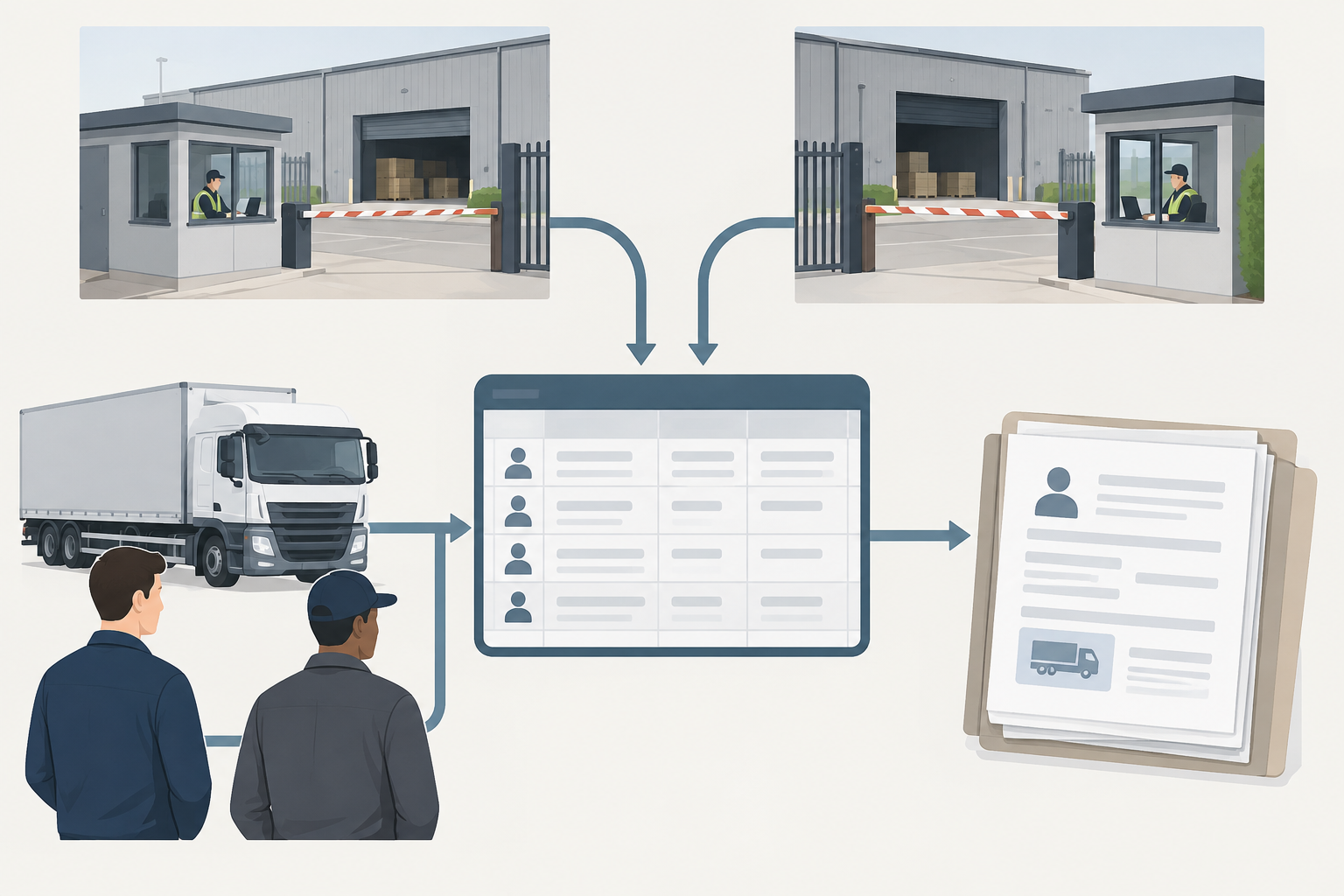
Handle a warehouse visitor log subject access request as a controlled disclosure—not as permission to send the shared gatehouse workbook. Record the request, establish the deadline, locate the driver’s personal data, assess mixed information and deliver a checked response.
The responsibilities and technical checks below are recommended operating practices. Legal timing, search and third-party rules are identified separately and linked to their statutory provisions. The privacy lead should resolve disputed interpretations and proposed exemptions before release.
| Owner | Recommended responsibility | Evidence of completion |
|---|---|---|
| Privacy lead | Approve identity sufficiency, timing, scope, search limits, third-party decisions and release | Dated decisions, deadline calculation, withholding reasons and release approval |
| Gatehouse records owner | Capture the request and account for entrances, paper records and local copies | Original receipt note, holdings inventory and completed search reports |
| Visitor-system administrator | Retrieve candidates, reconcile records and prepare tested disclosure files | Search history, match decisions, file reconciliation and delivery evidence |
Name deputies so a shift change or absence does not leave the request unowned. Keep search results and working copies in a restricted case area. NCSC’s Data security guidance, published and reviewed 11 May 2021, recommends locating data, protecting replicated copies and limiting access to authorised users. These controls apply to exported visitor records as well as the live system. NCSC: Data security
1. Recognise the request and record the deadline
A driver can make a subject access request verbally or in writing, to any part of the organisation. They do not need to name Article 15 or use the phrase “subject access request”; it must be clear that they want their own personal data. A request to an ordinary gatehouse contact therefore counts. HMRC: recognising subject access requests
Gatehouse action: recognise wording such as “Please send me everything you recorded about my visits.” Record the date, time, channel, receiving employee and the driver’s words. Preserve any dates, locations and contact details volunteered. For a verbal request, make a faithful note and check your understanding without making a written resubmission a condition of action.
The Department for Education’s guidance illustrates this reception problem: a staff member records a verbal request and passes it to the responsible lead rather than insisting on the organisation’s preferred form. That is a useful handling example, not the source of the timing rules below. DfE: receiving requests in different formats
Route the request promptly to the privacy lead and obtain acknowledgement. Retain the original receipt date; do not substitute the date the privacy team opened the forwarded message.
Apply the revised timing rules
Legal rule: section 76 of the Data (Use and Access) Act 2025 inserts Article 12A. It defines an applicable period of one month beginning with the relevant time, subject to the extension and clarification provisions below. Section 76: time limits
| Situation | Rule in Article 12A | What the privacy lead records |
|---|---|---|
| Ordinary request | The applicable period is one month from the relevant time. | Original receipt and calculated deadline; do not substitute a fixed 30-day period. |
| Identity information requested under Article 12(6) | The relevant time is the latest of receipt of the request, receipt of information requested under Article 12(6), and payment of any fee charged under Article 12(5). | The basis for any identity request and when the requested information arrived. This is not permission to impose routine ID checks or fees. |
| Necessary clarification | Where further information is reasonably required to identify the information or processing activities requested, the period from the day clarification is requested through the day it is received does not count. | Why clarification was reasonably required, both dates and the recalculation. This is a pause, not a fresh month. |
| Complexity or number of the individual’s requests | An extension of two further months is available where necessary for those reasons. Notice must explain the delay and be given before the initial one-month period expires. | Grounds, notice, notification date and revised deadline. |
| Clarification and extension notice | The same clarification interval is excluded from the period for giving the extension notice. | Both the response deadline and notice deadline, if affected. |
These distinctions come directly from Article 12A as inserted by section 76. An internal handover or a question about preferred file format is not, by itself, the statutory clarification condition.
Recommended control: set an earlier working target and have the privacy lead verify calendar edge cases before approving the final deadline. Do not wait until the last day to resolve an uncertain calculation. Requests are free in most cases; refer any proposed charge to the privacy lead rather than adding an export fee. GOV.UK: responding to a data protection request
2. Separate identity, scope and record matching
GOV.UK’s response guidance says to check the requester’s identity before replying. GOV.UK: checks before disclosure
Recommended approach: the privacy lead should assess what is already known, the contact route and the consequences of sending the records to the wrong person. Use proportionate verification; do not automatically collect a passport or driving-licence copy. Where identity remains uncertain, explain the concern and seek information that resolves it, offering an appropriate alternative where possible. Before adjusting the deadline, confirm that the request for identity information falls within Article 12(6), rather than assuming every verification question changes the clock.
Record the method, checker, date, outcome and reason further information was—or was not—needed. Prefer recording the verification outcome over retaining unnecessary identity-document copies.
Keep three decisions separate:
- Identity: is the requester the person they claim to be?
- Scope: which information or processing activities have they requested?
- Matching: does each candidate record concern that person?
A registration match answers none of these questions conclusively. A lorry may have several drivers; access to a carrier’s shared dispatch inbox does not establish which driver is writing. Use those identifiers to find candidates, then corroborate the individual records.
For genuinely ambiguous scope, ask a focused question about entrances, approximate dates or the information sought. Help the driver identify the relevant period rather than demanding a visit reference only the warehouse knows. Do not make narrowing a clear request for all their personal data a condition of searching.
Timing boundary: only reasonably required clarification to identify the information or processing activities engages Article 12A’s exclusion of time. Record that assessment separately from ordinary helpful correspondence. Section 76, Article 12A(5)
As an operating practice, continue work that does not depend on the outstanding answer. Keep the driver’s original wording alongside any agreed clarification.
3. Map holdings, referrals and deletion risks
Recommended owners: gatehouse records owner and administrator, with privacy-lead oversight. Map the sites, entrances, date boundaries and people responsible for the relevant holdings. Specify the time zone and distinguish visit dates from file creation or export dates.
Follow the actual record journey:
- Visitor-system profiles, visits, notes, attachments and relevant history.
- Shared gatehouse spreadsheets, local exports and reports sent to other teams.
- Paper sign-in books, loose fallback sheets and scanned copies.
- Relevant appointment information, correspondence and exception records.
- Other in-scope copies identified by records owners, including archived holdings requiring IT assistance.
Use the warehouse sign-in outage procedure to identify fallback records and reconciliation owners. A later digital entry may omit information written on the original paper sheet.
Route other requested data; do not silently exclude it. Give CCTV, access-control and correspondence owners acknowledged tasks, return dates and the relevant scope. Track these within the same case. The lost visitor badge procedure can help locate the credential-assignment history when a driver mentions a badge problem.
If another organisation controls particular records, have the privacy lead establish and explain that responsibility. Do not promise records the warehouse cannot obtain or label an unanswered referral “no data”.
Deal with imminent deletion explicitly
Alert the privacy lead immediately when relevant records approach scheduled disposal. Identify their location, relevance and expected deletion time. Obtain a documented decision on whether a narrowly scoped temporary retention measure is appropriate, its authority, access restrictions and review point.
Do not treat receipt of a request as a blanket instruction to preserve every visitor’s records indefinitely. Equally, do not allow an unresolved deletion risk to disappear into the routine job queue. Coordinate the approved decision with the warehouse visitor-log deletion process, keeping this access request separate from the routine disposal run.
4. Search reasonably and reconcile every candidate
Legal rule: section 78 of the Data (Use and Access) Act 2025 limits the entitlement to confirmation, personal data and other information that the controller can provide through a reasonable and proportionate search. The section states that its amendments are treated as having come into force on 1 January 2024. Section 78: reasonable and proportionate searches
Recommended application: the privacy lead approves coverage and any proposed stopping point. Consider likely relevance, the circumstances of the request and the effort involved. Record why a source was searched or why further work was judged disproportionate. Do not invent a universal hours or cost threshold, or treat an inconvenient export as an automatic exclusion.
| Search lead | Recommended search and corroboration |
|---|---|
| Name | Search known spellings, initials, spacing and recorded alternatives. Review similar-name candidates individually. |
| Carrier or shared contact | Find possible visits, then check person-specific appointment or visit information. Do not include every carrier visit. |
| Registration | Search relevant formatting variants and cross-check each result against the recorded driver and other reliable links. |
| Visit or delivery reference | Check the associated person, entrance and date; investigate conflicting assignments. |
| Paper and local copies | Inspect the relevant locations and periods, including notes missing from the main system. |
The administrator records the source, operator, search date, terms, filters, period, results and limitations. The records owner confirms physical and local-copy searches. An actual no-match search is different from an unanswered request to a colleague.
Separate duplicate copies from separate visits. A system entry and spreadsheet row with the same visit reference may represent one visit. A later arrival by the same driver is another visit. Before consolidating copies, compare notes, attachments and discrepancies: one copy may contain additional personal data.
Keep uncertain matches pending for review. Record the evidence used to include or exclude each disputed candidate. Escalate inaccessible sources and unresolved conflicts to the privacy lead instead of silently treating them as absent.
5. Assess third-party information before redacting
Legal rule: Schedule 2, paragraph 16 of the Data Protection Act 2018 restricts the obligation to disclose information where doing so would identify another individual. That restriction does not remove the obligation where the other person consents or where disclosure without consent is reasonable. DPA 2018: Schedule 2, paragraph 16
The privacy lead must consider all relevant circumstances when assessing reasonableness, including the type of information, any duty of confidentiality, steps taken to seek consent, the other person’s capacity to consent and any express refusal. Identification includes what the requester could work out using other information the controller reasonably believes they are likely to possess or obtain. Removing a name may therefore be insufficient. Paragraph 16(3)–(4): assessment and identifiability
Recommended review sequence: distinguish information solely about another visitor from information about the requester that also identifies someone else. Apply the statutory assessment to mixed information; do not treat every third-party reference as automatically withheld. Because the restriction applies only to the extent of the third-party disclosure, assess separable material rather than withholding an entire shared log by default.
| Content | Treatment to assess |
|---|---|
| Other visitors’ unrelated rows | Extract the requester’s information without including surrounding visitors. |
| A host’s name in a professional role | Consider context, confidentiality and reasonable disclosure; do not automatically remove every staff name. |
| A private telephone number | Assess separately from the host’s professional involvement. |
| A note involving two drivers | Preserve the requester’s information and useful context while assessing the other driver’s identifiable information. |
The decision record should identify the passage or field, the assessment, the approved treatment and the approver. Consent is not the only route to disclosure: the statute expressly provides for reasonable disclosure without it. Conversely, a professional role is not automatic permission to disclose everything about that person.
Choose a faithful disclosure format
GOV.UK describes the response as a copy of the person’s data, with understandable explanations. GOV.UK: what to provide
Recommended application: do not assume that means either an entire original workbook or a brief visit summary. Choose a clean extract, redacted source documents or a combination. Check that the result preserves the driver’s personal data, including notes and meaningful context, rather than reducing a detailed entry to “visit completed”. Do not remove an adverse comment merely because it is uncomfortable for the organisation.
Refer other proposed exemptions or refusals to the privacy lead for a separately documented legal assessment. A label such as “security” is not a completed reason for withholding.
6. Assemble an intelligible response and accompanying information
Legal baseline: GOV.UK says to provide confirmation of processing, a copy of the personal data and details of how it is collected, used and disposed of. Its guidance also identifies explanations about what information is used, why, where it came from and who can see it. The response should be transparent, accessible and written in clear language; explain codes. GOV.UK: responding to a data protection request
Administrator: arrange the approved data by visit or another intelligible order. Identify entrances, dates and references; explain abbreviations, status codes and time zones. Leave an unrecorded departure unrecorded. Clearly distinguish commentary written for the response from original gatehouse notes.
Reconcile the package against the approved search results, including profile information, notes, relevant attachments and materially different copies. A clean spreadsheet is not a complete package if a paper-only note has been missed.
Privacy lead: complete a separate check of the applicable Article 15 accompanying-information requirements before release. As a preparation checklist—not a substitute for that legal check—assemble the relevant explanations about:
- Processing purposes, categories of data and recipients.
- Retention periods or the criteria used to determine them.
- Available information about sources of data not collected from the driver.
- Applicable rights and how the driver can raise a concern or complain to the ICO.
- Any relevant international transfers and safeguards.
- Any relevant automated decision-making or profiling and the explanation appropriate to it.
Verify these statements with the responsible owners. Do not invent a retention period, claim there are no transfers without checking, or assume a generic privacy-notice link answers every question about this driver’s records.
Explain the scope covered, approved omissions and significant unavailable records. Where withholding or refusal is proposed, obtain privacy-lead approval of the legal basis and the required explanation and challenge information before sending it. For a completed search finding no relevant data, send a clear response explaining that result.
Agree a usable delivery format with the driver. Readability and completeness should be checked independently of whether the file opens successfully.
7. Test hidden content, redactions and secure delivery
Recommended release control: have a second authorised person inspect the actual delivery files, not merely the working extract.
- Reconcile included records with approved matches, exclusions and third-party decisions.
- Inspect hidden spreadsheet sheets, rows and columns, comments, formulas, external links, embedded objects and file properties.
- Check whether cached data, pivot tables, attachments or document layers retain information removed from the visible page.
- Test redactions by searching, selecting, copying and pasting, unhiding content and inspecting the final file with approved tools.
- Do not rely on black rectangles, white text or cropped views as permanent removal.
- Open every attachment independently and check legibility, filenames, metadata and explanations.
- Verify the intended recipient and destination separately from any shared carrier inbox.
NCSC recommends protecting data in transit and at rest, using secure encrypted and authenticated protocols where possible, and restricting access. File encryption can help control externally shared data. NCSC: Data security, 11 May 2021
For email specifically, NCSC’s guidance, reviewed 7 October 2019, explains protection of the transport channel using TLS and notes that individual-message encryption requires compatible arrangements at both ends. These are security considerations, not rules about SAR deadlines or exemptions. NCSC: Protect email in transit
Recommended delivery practice: use the organisation’s approved channel suited to the information and the driver’s access needs. Options may include authenticated file delivery, an approved encrypted-attachment process or a verified physical delivery arrangement. Where a separate secret is used, communicate it through a separately verified route.
Test that the driver can access only the approved package—not the working folder, source workbook or another visitor’s files. Transport encryption does not replace checking the recipient or attachment. Offer a practical alternative if the driver cannot use the proposed channel.
Record final file versions, checker, release approval, verified destination, dispatch time and delivery result. Investigate failures promptly rather than bypassing controls by sending the unprotected source log.
- Capture the original request Recognise A verbal request to the gatehouse can be a SAR; it does not need legal terminology or a specialist contact.
- Have the privacy lead approve timing Calculate Article 12A distinguishes the relevant starting time, necessary clarification pauses and extensions for complexity or number of requests.
- Find the person’s records—not every lorry match Search Apply the reasonable-and-proportionate-search rule. Recommended warehouse control: cover relevant entrances and copies, then corroborate shared identifiers.
- Review mixed information individually Assess For identifiable third-party information, consider consent or reasonable disclosure without consent and the statutory circumstances.
- Check the actual delivery files Test Recommended release control: reconcile the final extract and inspect hidden sheets, cached data, metadata and reversible redactions.
- Secure the package and record delivery Deliver NCSC recommends protecting data in transit and restricting access. Apply those controls to the approved package and verified destination.
Worked example: two entrances and a registration used by two drivers
Fully hypothetical example: all people, organisations, identifiers, records and operational outcomes below are fictional. The identity method and temporary-retention decision are illustrative, not universal rules.
On 3 November 2026, Alex Rowan telephones fictional Merebank Warehouse: “Please send me the information you hold about my September visits through both gates, including my badge problem and any footage.”
Gatehouse operator Jo records the words and receipt time and obtains privacy lead Priya’s acknowledgement that day. Priya confirms identity through an existing individually assigned contact route and corroborating information already held. She records that no additional identity information or necessary scope clarification is outstanding. The ordinary one-month deadline is 3 December 2026; the team plans to finish sooner.
Records owner Ellis identifies the North and South entrances, the visitor system, a shared gatehouse spreadsheet, September exports, appointment records and a South-entrance paper fallback sheet. Priya gives the access-control and CCTV owners acknowledged tasks covering the badge problem and footage.
Searches and decisions
Administrator Sam searches both entrances for Alex Rowan, A Rowan and Rowan, then checks the carrier name, shared dispatch contact, visit references and fictional registration MB26 XYZ, with and without its space. Ellis examines the paper records. Each completed search records its period, terms, filters and results.
| Candidate | Fictional findings | Decision |
|---|---|---|
| N-104, 8 September | Alex appears in the system and workbook with matching visit reference and times. | One visit represented twice. Compare contents before consolidating. |
| S-219, 15 September | A Rowan appears on paper and in a later digital entry; appointment information corroborates Alex. | A separate Alex visit. Preserve the paper-only note. |
| S-227, 16 September | MB26 XYZ matches, but the recorded driver and appointment identify Casey Bell. | Exclude the mistaken match. The shared lorry does not make Casey’s visit Alex’s record. |
| N-131, 24 September | Alex appears with MB26 XYZ; departure is blank. | A third Alex visit. Explain that departure was not recorded. |
The shared dispatch contact returns other carrier visits. Person-specific checks identify none as Alex’s. The exports contain copies of Alex’s three visits but no additional content. Ellis confirms the paper search is complete. Sam reconciles three distinct visits, not one visit per matching file.
Third-party assessment
The South paper note describes Alex waiting for a gatehouse decision and also records Casey’s unrelated personal circumstances. Priya approves release of the account about Alex while removing Casey’s unrelated information. She checks that the remaining wording still explains Alex’s wait without making the removed information apparent.
Priya assesses a host’s professional involvement separately from the host’s private mobile number. In this fictional case, she records why disclosure of the professional name is reasonable without consent, while removing the private number. She does not apply a blanket rule to all staff names.
Other records and deletion risk
The access-control owner supplies the relevant credential events. The CCTV owner checks camera coverage and storage and confirms that September footage expired before the request arrived. Priya includes that result in the response rather than silently omitting footage.
A local export is due for routine disposal during the search. Priya authorises a restricted case copy of the relevant information, documents the authority and sets a review point after delivery. She does not direct indefinite retention of the export’s unrelated visitor records.
Final package and closure
The package contains:
- A readable extract of Alex’s profile and three visits, including arrival details, recorded departures and applicable notes.
- The redacted South paper note containing information missing from the system.
- The relevant credential-event extract with its codes explained.
- A covering response confirming processing, describing the scope searched and explaining the missing departure, unavailable footage and approved omissions.
- The accompanying processing information approved by Priya after her Article 15 check.
Neither the full shared spreadsheet nor Casey’s visit is attached. A second administrator reconciles the files, inspects hidden content and metadata, and tests whether redactions can be reversed. Priya approves release.
On 12 November, Sam delivers the package through an approved authenticated channel to Alex’s verified destination and records successful access. Priya confirms that all source owners have replied and no search or delivery task remains outstanding. Temporary working copies receive an approved disposal decision. A separate operational task addresses the missing-departure process without inventing a historical departure time.
8. Close with a traceable decision record
Recommended owner: privacy lead. Before closing the request, reconcile its original wording, identity and scope decisions, search coverage, approved package and delivery outcome.
Keep a restricted case history showing:
- Receipt and the deadline calculation, including any approved adjustments.
- Identity verification and the reason for any necessary clarification.
- Sources searched, responsible operators, results and limitations.
- Decisions on ambiguous matches, duplicate copies and third-party information.
- What was disclosed or withheld, the approval and the final files sent.
- Dispatch, delivery outcome and follow-up actions.
Give unresolved matters a named owner, next action and review date. An unfinished CCTV referral, failed delivery or unanswered records-owner task must not disappear behind a “visitor log sent” status. Explain any partial response and manage outstanding work explicitly.
Apply approved access and retention arrangements to the case history. Review temporary retention measures and working-copy cleanup; do not keep unrestricted exports indefinitely. Keep later operational corrections traceable and separate from the record of what was searched and disclosed.
Conclusion
A defensible response connects the original request to completed searches, disclosure decisions and the files actually delivered. Keep identity separate from record matching, visits separate from duplicate copies, and third-party assessment separate from blanket withholding. Close only when the privacy lead has approved the response and outstanding work has been resolved or explicitly assigned.
Sources
Source pages checked 10 November 2026.
Pricing and plan details can change; verify current terms with the vendor.