

Before the alarm: assign accountability and reporting
Before using this procedure, establish:
- A named accountability lead and deputy for every shift, responsible for consolidating non-employee reports.
- A reporting owner for each designated assembly point, with an agreed backup.
- An approved visitor-record source and fallback, covering gatehouse, contractor and other arrival records.
- An agreed reporting route to the incident lead, including an alternative communication method and acknowledgement of urgent discrepancies.
These are recommended administrative arrangements for local approval. Great Britain’s HSE recommends competent emergency leadership, clearly rehearsed responsibilities and provision for night and shift working in its emergency-procedures guidance, updated 16 March 2023. Canadian CCOHS guidance recommends a coordinator, backup personnel, defined responsibilities and a predetermined command structure; it also notes that legal requirements vary by jurisdiction. See CCOHS Emergency Planning, accessed 2 November 2026. Neither source prescribes this exact warehouse reconciliation method.
Recommended operating assumption: treat every sign-in roster as a starting list requiring reconciliation—not as a guaranteed complete emergency roster. Use visitor records to support, never replace, the approved emergency arrangements and physical accountability.
The procedure below concerns non-employees only. Follow the site’s emergency instructions; do not delay evacuation to retrieve a device, print a list or complete sign-out. Do not conduct untrained searches or permit unauthorized re-entry. Route response decisions through emergency command rather than through the visitor-record administrator.
1. Take a timestamped roster snapshot
Recommended sequence: once in the location required by the emergency plan, the accountability lead or deputy takes the latest safely available roster snapshot. Record the incident reference, snapshot time, record source, last known update time and entrances covered. Preserve that baseline rather than overwriting it as reports arrive.
Include recorded drivers, contractors and other visitors whose presence or departure needs checking. Add available manual arrivals and reported omissions as separately identified evidence. Keep expected-but-not-confirmed arrivals distinct from people known to have entered.
If records are unavailable or stale, report that limitation immediately. Mark missing entrance coverage or unknown occupancy explicitly; do not present a partial list as a complete site count. Prepare this fallback beforehand using the warehouse network-outage recovery procedure.
Maintain separate information for each person:
| Information | What to preserve |
|---|---|
| Recorded visit status | Signed in, signed out, no entry found or record unavailable, with its source and time |
| Confirmed physical presence | Who directly confirmed the person, where and when |
| Accountability disposition | Confirmed at an assembly point, confirmed elsewhere under the emergency plan, confirmed departed under approved checks, or unresolved |
A later correction should supplement the original record, not erase the discrepancy.
2. Collect physical reports from every assembly point
Recommended reporting practice: each assembly-point owner reports identified people physically present, the observation time, their own name and any identity uncertainty. Report people absent from the roster as well as those listed. Send initial reports promptly, then updates; do not wait for every discrepancy to be solved.
Ask explicitly about drivers, contractors and accompanying passengers. Include drivers whose last reported location was outside the building: a cab, yard or loading area is a location report, not automatic confirmation of accountability. Any confirmation outside an assembly point must follow the approved emergency arrangements and identify the person, observer, location and time. Do not create an improvised alternative muster location.
Use names and visit references where available—not headcounts alone—to reconcile across assembly points. If someone is reported at another point, obtain confirmation from that point’s owner. Do not send the person between points merely to satisfy the roster.
For contradictory or duplicate reports, preserve both reports and their times while establishing the latest confirmed position. Count the person once. Mark an assembly point that has not reported as report outstanding, not as empty.
Before an incident, align driver and passenger identification with the gatehouse-to-loading-bay workflow, and contractor identity and host details with the contractor sign-in exception procedure.
3. Reconcile discrepancies without erasing uncertainty
Recommended decision rules: apply the following branches to the combined roster and physical reports. Under this procedure, a vehicle location, host assumption or digital sign-out alone is insufficient to establish a person’s safety.
| Evidence received | Decision and record |
|---|---|
| Signed-in person directly confirmed at an assembly point | Match identity; record point, confirming owner and observation time. Mark physically confirmed without changing the original signed-in status. |
| Person reported at another assembly point | Ask that point’s owner to confirm identity and presence. Once confirmed, reconcile the original point’s absence and count the person once at the confirmed point. Until then, retain the uncertainty. |
| Claimed departure without adequate confirmation | Retain the departure claim, its source and time, but keep whereabouts unresolved. Seek person-specific evidence through approved channels without delaying escalation. |
| Unsigned-in passenger physically present | Add a distinct incident entry, recording identity as established, associated driver, point, observer and time. Count the passenger separately; do not backdate a sign-in. If identity is uncertain, distinguish an observed person from a matched roster identity. |
| Visitor cannot be located | Mark unresolved and promptly notify the incident lead. Preserve the last reliable sighting and any conflicting reports. Do not infer departure from silence. |
Agree departure-confirmation criteria before an incident. For example, a locally approved check might combine a named exit operator’s person-specific observation with direct confirmation from the visitor at an off-site location. This is a proposed practice, not a universal evidential standard. Record what was actually established, who accepted it and when; leave unknown details unknown.
Never resolve uncertainty by silently deleting an entry or signing someone out. Keep confirmed departures separate from people physically present at muster.
4. Escalate unresolved people and update command
Recommended escalation: report unresolved people as soon as identified; continue reconciliation in parallel. Do not wait for the final total or an unanswered host call.
Give the incident lead the person’s identity or description, visitor category, last reliable location and time, reporting witness, conflicting departure evidence and checks already attempted. Include any missing assembly-point report or roster coverage gap. Obtain acknowledgement; if the primary channel fails, use the approved backup route.
Report separate totals for people confirmed at assembly points, people confirmed elsewhere under the plan, confirmed departures and unresolved people. State the report time and coverage limitations. These are counts of the identified reconciliation population, not a claim that nobody else could be present.
Send later confirmations as timestamped updates and obtain acknowledgement of changes to unresolved cases. Leave searches, rescue, re-entry and all-clear decisions with authorized emergency command. HSE’s Great Britain guidance calls for competent people to take control and says work should not resume while serious danger remains. The administrative prohibitions here are recommended boundaries, not a substitute for site-specific responder procedures.
5. Worked reconciliation: two assembly points and an uncertain departure
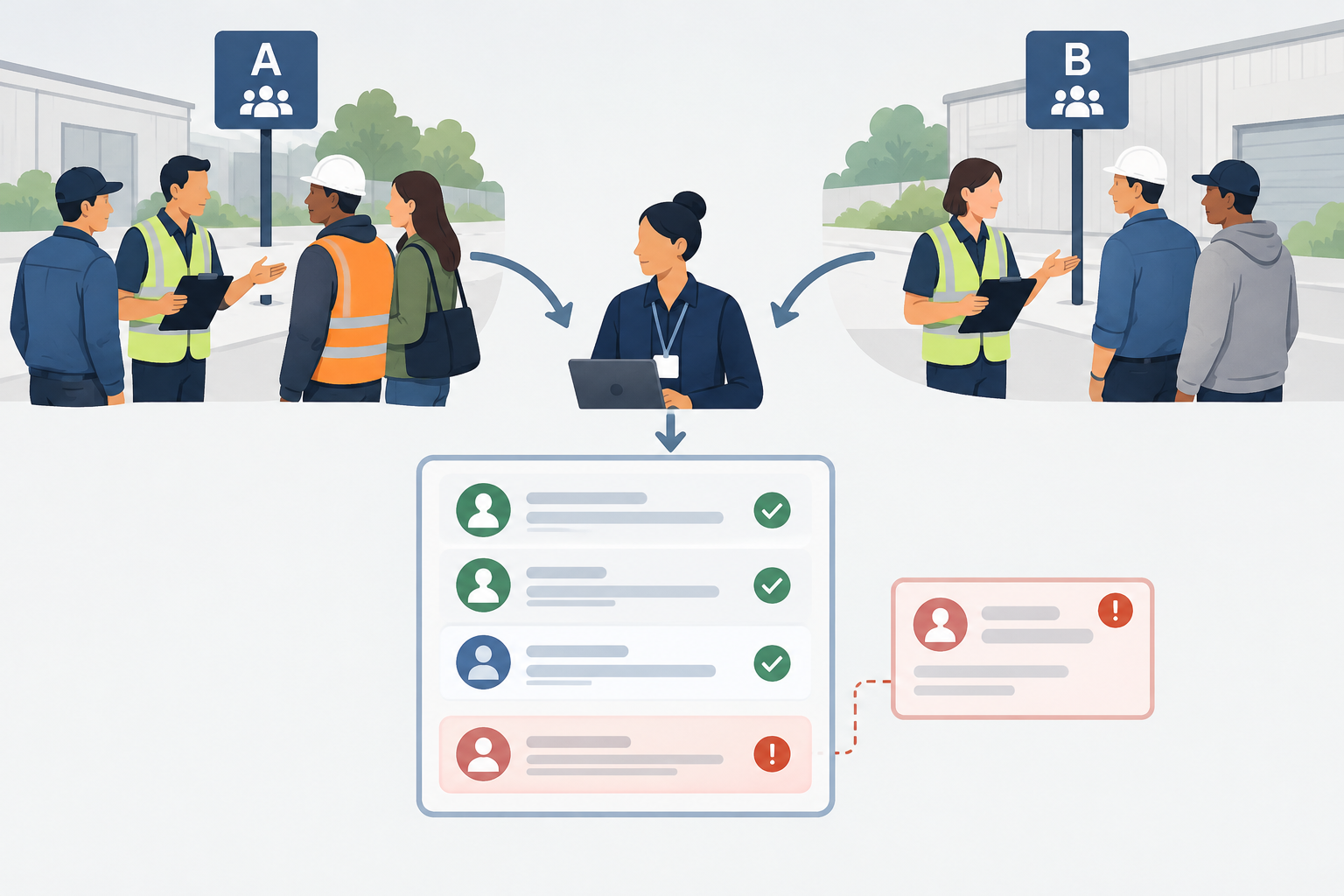
Fully hypothetical example: all names, times, observations and decisions below are invented. The fictional site uses assembly points A and B.
At 10:02, accountability lead Morgan preserves a roster showing driver Dana, contractor Luis and visitor Erin signed in. Passenger Jo has no visitor entry. Initial reports arrive at 10:04; the reconciliation position below is reached at 10:06. These times illustrate a sequence, not response targets.
| Person | Initial evidence | Decision and final position |
|---|---|---|
| Dana, driver | Signed in; truck shown at Bay 4. Point A owner directly identifies Dana at 10:04. | Confirm Dana at A using the physical report—not the truck location. Retain signed-in visit status. |
| Luis, contractor | Signed in and expected at A, where Luis is absent. A colleague says Luis went to B. | Initially unresolved. At 10:05, B’s owner directly confirms Luis. Record B and remove the unresolved flag through a logged update; count Luis once. |
| Jo, passenger | No sign-in. Point A owner meets Jo, establishes Jo’s name and confirms Jo accompanied Dana. | Add an incident-only entry linked to Dana’s visit. Confirm Jo separately at A; retain the missing-sign-in discrepancy. |
| Erin, visitor | Signed in at snapshot. Host assumes Erin left; a digital sign-out appears at 10:03. Neither point reports Erin, and no person-specific departure confirmation is available. | Record the sign-out and host claim separately. Whereabouts remain unresolved; incident lead is notified at 10:04 and acknowledges. |
Final position at 10:06: A has 2 confirmed people—Dana and Jo. B has 1 confirmed person—Luis. Across both points, 3 people are physically confirmed, 0 have confirmed departures and 1 remains unresolved. The reconciliation population is 4 distinct people: the original 3 roster entries plus Jo. Luis is not counted at both points, and Jo is not absorbed into Dana’s entry.
Morgan reports Erin’s unresolved whereabouts and the acknowledged escalation alongside the totals. Erin is not labelled definitely inside the building or safely departed; both conclusions remain unsupported in this hypothetical incident.
- Preserve the baseline 3 recorded visits Dana, Luis and Erin are signed in on the hypothetical 10:02 snapshot.
- Include the unsigned-in passenger 1 additional person Jo is physically confirmed as Dana’s passenger and receives a separate incident entry.
- Reconcile both assembly points 3 physically confirmed Dana and Jo are at A; Luis is confirmed at B and counted only once.
- Escalate rather than clear 1 unresolved Erin’s departure remains unconfirmed; the incident lead acknowledges the discrepancy.
6. Preserve the record and demonstrate the correction
Recommended record preservation: retain the original roster snapshot, timestamped assembly reports, incident-only additions, conflicting claims, identity matches, status changes and incident-lead acknowledgements together. Record who made each decision and the evidence available at that time. Preserve an unknown departure time rather than inventing one.
After emergency command permits administrative recovery, reconcile routine visit records separately. Keep the incident history intact and apply the organization’s approved access and retention arrangements. Assign each identified process defect an owner and a completion check.
Idaho’s Office of Emergency Management describes exercise evaluation and improvement planning in its Exercise Program Toolkit, last updated 6 March 2023. It is guidance for Idaho local jurisdictions and agency partners, not a warehouse-specific legal requirement; the following tabletop applies that evaluation approach administratively.
Completed hypothetical tabletop: the team replays Erin’s discrepancy. The gatehouse operator reports the digital sign-out; the assembly owners report no physical confirmation. Morgan sends the incident lead Erin’s identity, last witnessed location, unverified departure claim and current unresolved status. The incident lead acknowledges and retains Erin as unresolved while directing further action through the emergency plan. No participant goes searching or re-enters.
The debrief identifies the failed handoff: the host’s departure assumption had been entered without person-specific confirmation. The gatehouse supervisor takes ownership of the correction, separates departure claims from confirmed departures in the local procedure and briefs the shift teams. In the repeat tabletop, the operator preserves the claim as unverified and the incident lead receives and acknowledges the unresolved case. The drill record retains both the original failure and the completed correction.
Conclusion
Keep recorded visit status, physical confirmation and unresolved whereabouts separate. Report uncertainty promptly, preserve every correction and use the site’s emergency command process—not a cleared visitor list—to govern the response.
Sources
Source pages checked 29 October 2026.
Pricing and plan details can change; verify current terms with the vendor.